Building a Crypto Exchange Using Serverless Functions
Using serverless boundaries and Appwrite to scale complexity without scaling teams.
November 2025
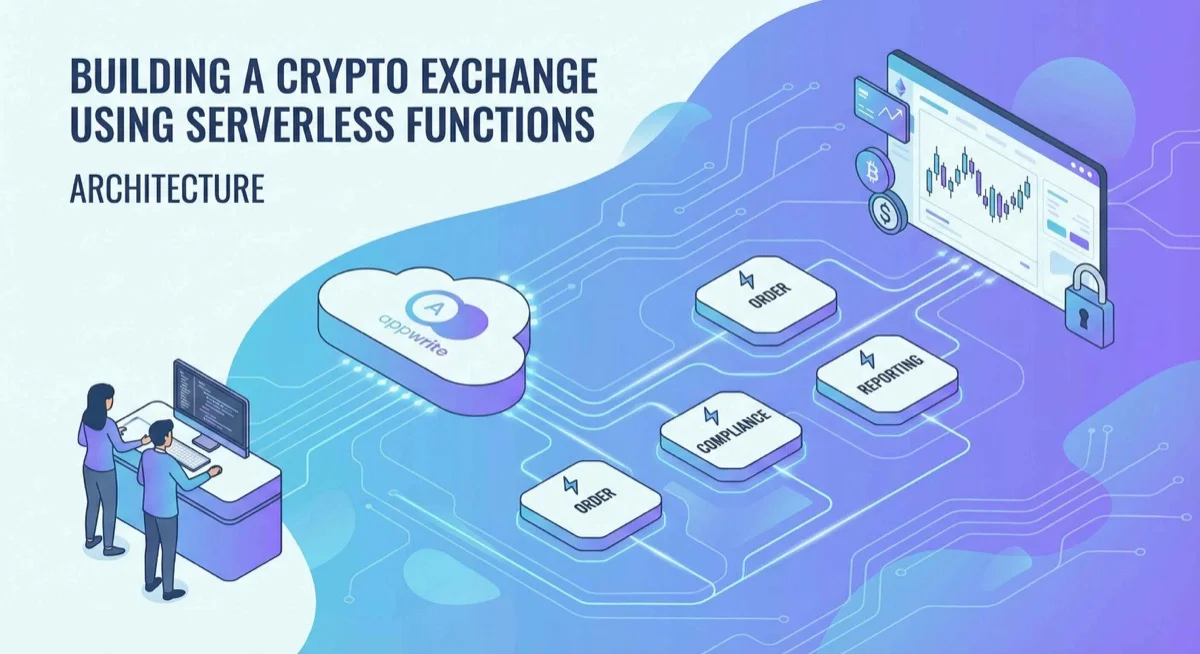
Crypto exchanges are often over-engineered from the first day. Teams anticipate scale, volatility, security threats, and regulatory scrutiny, and respond by building heavy infrastructure long before they understand how the system will actually be used. The intention is safety. The result is usually rigidity. Complexity shows up early, while operational clarity arrives late.
This note describes a different architectural path: using serverless functions and Appwrite not as shortcuts, but as intentional boundaries—to let a crypto exchange evolve safely under real-world pressure.
The focus here is not on specific cloud providers or implementation details, but on why certain architectural constraints mattered more than raw performance.
A crypto exchange is not just a trading engine. It is a financial ledger, a real-time coordination system, a security boundary, and a compliance surface—simultaneously. Any architecture that prioritizes throughput before correctness is fragile by design.
From the beginning, the system was optimized for auditability and correctness first, and only then for speed. This ordering shaped every subsequent decision.
Serverless functions are often dismissed in exchange architectures because of latency concerns. That criticism is valid, but incomplete. The mistake is assuming that all parts of an exchange are latency-sensitive.
Execution paths—matching engines, price updates, order placement—do require tight latency guarantees. Coordination paths do not. User identity, wallet updates, compliance checks, reporting, and audit trails benefit more from isolation and clarity than from microsecond optimization.
Once that distinction is made explicit, serverless stops being a liability and starts enforcing discipline.
In this architecture, Appwrite was not treated as a generic backend-as-a-service. It acted as a control plane. Authentication, session management, identity enforcement, and access boundaries were centralized deliberately, so that application logic could focus on domain behavior instead of re-implementing security and consistency concerns across services.
This separation reduced surface area for mistakes. It also made the system easier to reason about under audit or incident review.
Rather than building long-lived services, the system was decomposed into functionally isolated units. Each serverless function had a single responsibility, explicit input and output contracts, and clear ownership boundaries. Market data ingestion, order coordination, wallet operations, compliance workflows, and reporting logic evolved independently.
This reduced coupling in ways that traditional service decomposition often fails to achieve. Failures became localized. Debugging became tractable.
Coordination between components avoided long synchronous chains. Instead, the system relied on event-driven flows. An order placement emitted downstream wallet updates. A trade execution produced audit and notification events. Changes in KYC state propagated through compliance and access layers without blocking core trading paths.
The key property was decoupling: failures in reporting or notification could not interfere with execution. Critical paths stayed narrow and observable.
Wallet design required particular care. Mutable balances fail under concurrency, especially in financial systems. Wallets were modeled as append-only transaction ledgers. Balances were derived, not stored. Deposits and withdrawals followed explicit state machines, with short-lived and intentional locking.
Serverless execution fit naturally here. Each transaction could be processed atomically, independently, and with clear retry semantics.
Compliance was treated as a first-class system concern, not an afterthought. Every meaningful action emitted an audit event. Compliance logic consumed the same event stream as business logic. Regulatory reporting emerged as a derived view of system behavior rather than a parallel, manually maintained pipeline.
This ensured that compliance evolved alongside product features instead of lagging behind them.
Real-time guarantees were applied selectively. WebSockets handled market data and order book updates where immediacy mattered. Administrative views and reporting relied on eventual consistency. Heavy aggregation and analysis ran in background jobs.
By keeping the real-time surface area intentionally small, the system remained observable and debuggable.
Failures were expected, not feared. Serverless systems fail differently, and the architecture embraced that reality. Functions were idempotent. Event handlers were retry-safe. Irrecoverable states surfaced through dead-letter queues. Alerts were human-visible rather than hidden behind silent retries.
The goal was not zero failure. It was controlled failure.
At a system level, this architecture did not optimize for maximum throughput or infrastructure novelty. It optimized for small teams operating complex systems, incremental scaling under real usage, auditability, and clear mental models for operators.
That tradeoff proved decisive.
Serverless functions and Appwrite are not magic tools. Used poorly, they add latency and confusion. Used intentionally, they enforce architectural discipline.
The core insight is simple:
architecture should reduce the cost of being correct.
For crypto exchanges—where trust, correctness, and auditability matter more than raw speed—serverless boundaries can be an asset rather than a compromise.