State of the Art – Fair and Efficient Allocation
Where fairness meets efficiency, computation, and structural constraints.
December 2025
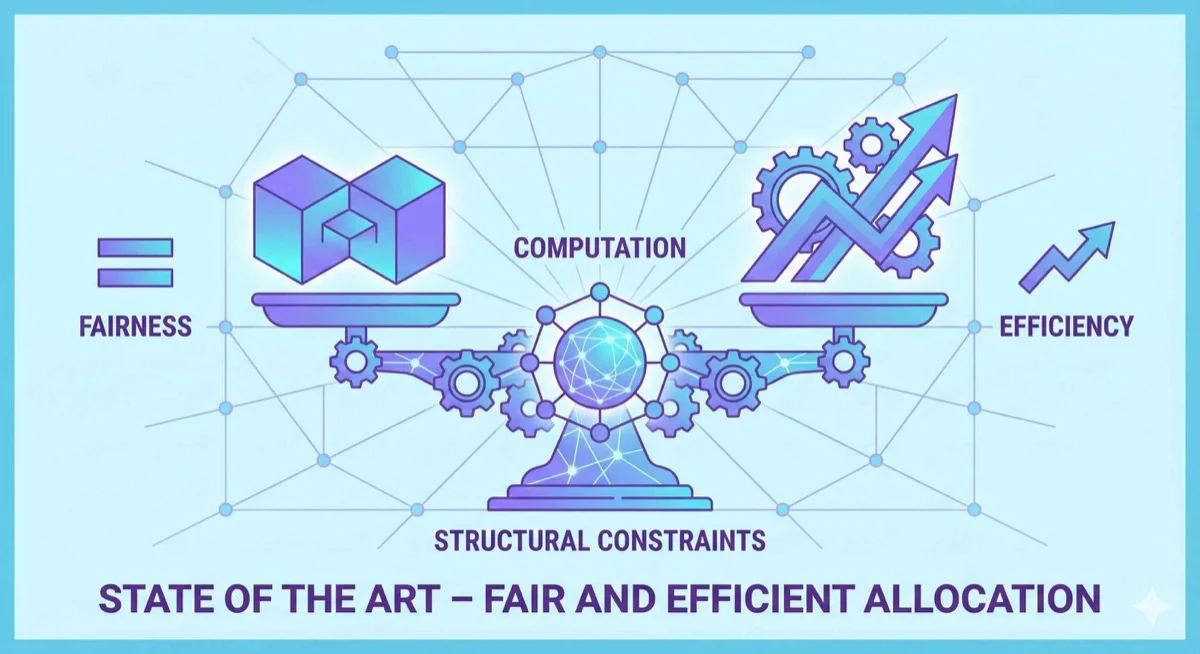
Fair allocation lives at an uncomfortable intersection of ethics, economics, and computation. The motivating question sounds simple: how should resources be allocated so that outcomes are fair to individuals and efficient for the group as a whole? Yet as soon as goods become indivisible and preferences heterogeneous, many of the guarantees we would like to rely on simply disappear.
This tension has shaped the modern theory of fair allocation. Rather than converging toward a single “correct” notion of fairness, the field has evolved into a careful study of trade-offs—between fairness and efficiency, between expressiveness and tractability, and between idealized guarantees and what computation can realistically support.
Why exact fairness breaks down
Classical fairness notions such as envy-freeness and proportionality originate in divisible settings like cake cutting, where continuity makes strong guarantees possible. In those models, fairness is often treated as a baseline requirement rather than an aspiration.
With indivisible goods, that baseline collapses almost immediately. A single indivisible item shared between two agents already violates proportionality for one of them. This is not an edge case—it is a structural limitation.
The breakdown is not only existential but computational. Even under simple additive valuations, deciding whether an envy-free or proportional allocation exists is NP-complete. As a result, exact fairness in indivisible settings is no longer treated as a default goal. It functions instead as an idealized reference point against which more realistic notions are measured.
Relaxation as the new baseline
To recover feasibility, the literature shifted toward relaxed fairness notions—definitions that weaken classical guarantees in controlled and interpretable ways.
The most influential of these is envy-freeness up to one item (EF1). Under EF1, any envy an agent feels toward another can be eliminated by hypothetically removing a single item from the other agent’s bundle. Proportionality admits a similar relaxation through PROP1.
These notions are not arbitrary compromises. Under additive valuations, EF1 and PROP1 are guaranteed to exist and can be computed efficiently, while still capturing an intuitive sense of fairness. Over time, EF1 has effectively become the default fairness notion in computational allocation.
Stronger relaxations such as envy-freeness up to any item (EFX) are conceptually appealing, but their status remains unresolved in general. Even for additive valuations, the existence of EFX allocations with four or more agents is still an open problem. This gap illustrates how fragile fairness guarantees become as soon as we strengthen them slightly.
Efficiency re-enters the picture
Fairness alone is not sufficient. Allocations must also be efficient, typically formalized through Pareto optimality.
Here the tension sharpens. Exact envy-freeness is incompatible with Pareto optimality for indivisible goods, forcing a choice between ethical and economic desiderata. One of the major advances of the past decade is the realization that approximate fairness and efficiency can coexist.
In particular, allocations that satisfy both EF1 and Pareto optimality are guaranteed to exist under additive valuations. However, known algorithms are only pseudo-polynomial, and whether strongly polynomial-time algorithms exist remains open.
This triangle—fairness, efficiency, and computation—defines much of the modern research frontier. Improving one corner almost always stresses the others.
Moving beyond additive valuations
Additive valuations dominate the literature largely because they make progress possible. They are also a poor proxy for many real-world preferences, which often involve diminishing returns, complementarities, or substitution effects.
Once additivity is relaxed, results become fragmentary. For monotone valuations, EF1 existence is still guaranteed, but its compatibility with Pareto optimality is unclear. For submodular and XOS valuations, approximate fairness guarantees exist, yet tight combinations of fairness and efficiency remain elusive. For supermodular valuations, most positive results vanish entirely.
These patterns suggest that the structure of valuation functions plays a decisive role. Understanding how specific structural properties enable or obstruct fairness guarantees is one of the field’s central open directions.
When structure helps rather than hurts
Interestingly, recent work shows that constraints—often seen as complications—can restore tractability.
Graphical house allocation is a prominent example. Here, agents only compare allocations with their neighbors in a social graph, making fairness a local rather than global notion. The structure of the graph becomes a computational resource.
Even in this restricted setting, minimizing envy is NP-hard in general. Yet for specific graph classes such as paths, trees, or graphs of bounded treewidth, exact or fixed-parameter tractable algorithms are possible. These results point to a broader principle: fairness becomes more manageable when the interaction structure is exploitable.
Rather than treating structure as an obstacle, modern approaches increasingly treat it as leverage.
Payments and their limits
Allowing monetary transfers dramatically simplifies the picture. With payments, envy-free and Pareto-optimal outcomes always exist under additive valuations, and can often be computed via assignment-market formulations.
However, payments introduce their own modeling concerns: feasibility, interpretability, and equity of transfers. In many domains, monetary compensation is either undesirable or infeasible. For this reason, much of the literature continues to focus on payment-free models despite their inherent difficulty.
What remains open
Despite decades of progress, several foundational questions remain unanswered. Among them:
- Does an EFX allocation always exist for four or more agents with additive valuations?
- Can EF1 and Pareto optimality be achieved together in strongly polynomial time?
- How far can fairness guarantees be extended beyond additive and submodular valuations?
- Are there intermediate notions between EF1 and EFX with universal existence?
- How do structural constraints on agents or goods reshape the fairness–efficiency frontier?
These are not technical curiosities. They define the boundary between what fair allocation systems can promise in theory and what they can deliver in practice.
Closing perspective
Modern fair allocation theory has moved away from idealized guarantees toward a more nuanced understanding of trade-offs, approximations, and structure.
Fairness is no longer binary. It is negotiated against efficiency, expressiveness, and computational feasibility. The emerging direction is clear: embrace principled relaxations, exploit structure wherever it exists, and design algorithms that respect both human intuitions of fairness and the hard limits imposed by computation.